
Are there really tyres that don't require tyre warmers?
A technical analysis on pressure, safety and performance in motorsport.

In recent years, some manufacturers have introduced racing tires to the market, claiming that they can be used without thermal blankets. The promise is simple: thanks to new compounds, the tire is able to develop a level of grip quickly enough already after the first turns. This is undoubtedly an important technological advancement. But does this evolution really mean that thermal blankets are no longer needed? The answer, from our point of view, is no. Not because the new compounds don't work. But why the problem that thermal blankets solve is not just grip. The real problem is the pressure exerted by the tire. And it is a problem that no new tire compound can eliminate.
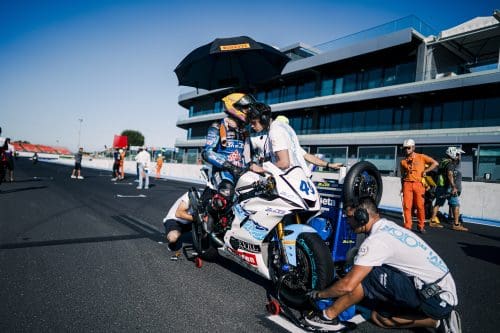
Grip and pressure are two completely different things.
💡 When it comes to tires without thermal blankets, a very common mistake is made. The concept of adherence is confused with that of the pressure of exercise. They are two completely different phenomena. The grip depends primarily on the tire compound and its ability to reach the working temperature quickly. The pressure, however, depends on the temperature of the air contained within the tire and the thermal balance between the tire, the air, and the rim. A mixture can become effective very quickly. The pressure, on the other hand, continues to change for several minutes. And it is precisely this difference that makes thermal blankets still essential today.
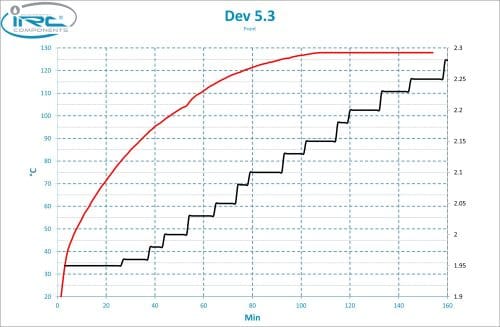

Red line Temperature of the tread. Black line Pressure. Achieving grip does not coincide with achieving the operating pressure. If set to 90 degrees, the temperature is reached in about 40 minutes, but the pressure stabilizes after another 40 minutes.
Pressure is not our opinion. It is a safety parameter.
Some might think that the pressure is simply a useful parameter for improving lap time. In reality, it is much more than that. It is a safety parameter. The demonstration comes directly from the highest level of motorcycle competitions. In MotoGP, every motorcycle is equipped with a TPMS (Tyre Pressure Monitoring System) that continuously measures the pressure and temperature of the tires. It is not a choice made by the individual team. It is provided for in the regulations. Why? Because tire manufacturers define precise pressure values within which the tire is designed to operate. If the pressure remains below the regulatory limit (1.8bar front and 1.68bar rear) for a number of revolutions higher than the allowed one, the driver is penalized: Pirelli Minimum pressures In MotoGP, thermal blankets and TPMS systems are used simultaneously. Two different technologies with the same objective: ensuring that the tire operates under the conditions specified by the manufacturer.

Modern compounds have improved grip in the first few meters of use. However, most professional teams continue to use the thermal liners for a very specific reason: to ensure that the tire performs from the very beginning under the correct pressure conditions.
If they check tyre pressure in MotoGP, why should the physics be any different for an amateur?
The answer is simple. It's not different. The laws of physics are identical. The speeds change. Times change on the track. The pilot's level changes. But a tire continues to behave in exactly the same way. The air increases in pressure as the temperature increases. The carcass changes its rigidity. The footprint on the ground changes. The dynamic behavior of the motorcycle evolves progressively. In MotoGP this phenomenon is constantly monitored because the drivers drive to the absolute limit. But that doesn't mean that the phenomenon doesn't exist during a normal track day. It simply means that the amateur pilot might notice it less. The physics, however, remains the same. And it is precisely this physics that makes thermal blankets still essential today.
What do the new tyres really promise?
It is important to be clear. The new racing tires represent a real technological evolution. The new compounds allow for a rapid achievement of a sufficient level of grip. This reduces the risk of loss of grip in the very first meters. There is no doubt about that. But this is where the main misunderstanding arises. Many motorcyclists think that if the tire is at the correct temperature, it has already reached its proper operating conditions. That is not the case. The fact that a tire develops grip quickly does not mean that it has already reached the operating pressure specified by the manufacturer. They are two completely different phenomena. And it is here that the role of thermal blankets comes into play.
A fundamental concept
A modern tire can offer a good level of grip already after a few turns. This does not mean that pressure, internal air, and the ring have already reached their own thermal equilibrium. Until then, the pressure continues to change. And with it, the behavior of the motorcycle also continues to change.
What really happens in the first few minutes?
At this point, it is useful to forget for a moment the commercial slogans and observe what really happens to a tire when the bike leaves the pit lane. Many motorcyclists imagine that the tire heats up uniformly. Actually, that's not the case. Each component heats up at a different speed. The tread surface quickly reaches the operating temperature. The carcass takes longer to cook. The air contained inside continues to gradually heat up. The circle, being an important metallic mass, requires even more time. Until these elements reach a thermal equilibrium, the pressure also continues to change. And it is precisely this continuous variation that changes the behavior of the motorcycle.
h3>The problem isn’t having the wrong pressure. The problem is that it keeps changing.
This is probably the least known aspect. Many people think that it is enough to achieve “more or less” the correct pressure. Actually, the main problem is another one. A motorcycle that changes its behavior from lap to lap continuously forces the rider to adapt. They change: the entrance into the curve; the steering response; the support of the carcass; traction in acceleration; The stability is slowing down. With each lap, the bike is slightly different from the previous one. The more the pilot increases the pace, the more these variations become evident. And it is precisely for this reason that pressure represents a fundamental parameter for safety. Not because a difference of a few tenths of a bar automatically causes a fall. But why does it reduce the predictability of the motorcycle? And when a motorcycle becomes less predictable, the risk of error also increases.

Modern compounds have improved grip in the first few meters of use. However, most professional teams continue to use the thermal liners for a very specific reason: to ensure that the tire performs from the very beginning under the correct pressure conditions.
What happens when you stop between shifts?

The graph above shows how, within a few minutes of removing the tyre blankets, the surface temperatures and above all the internal pressure plummet. Therefore, at the start of every shift, the tyres are back to their initial conditions: acceptable initial grip but incorrect pressures.
The great forgotten one: the circle
When it comes to thermal blankets, almost all the attention is focused on the tire. In reality, there is a component that directly influences pressure stabilization and that is often underestimated. The circle. Being made of metal alloy, it represents a significant mass that absorbs heat slowly. When the motorcycle leaves the garage, the tread can start to heat up quickly. The circle, however, remains cold. This temperature difference causes a continuous transfer of heat between the tire, the internal air, and the rim. The result is simple. The pressure continues to change even when the driver already perceives a good level of grip. For this reason, it is not enough to simply heat the surface of the tire. The goal should be to bring the entire system — tire, internal air, and rim — as close as possible to the conditions of use. Pressure is not just a performance parameter. It is a safety parameter. IRC Components does not claim this. This is demonstrated by the regulations of the main international motorcycle racing competitions. It continues to increase even after the compound has reached the operating temperature. The tire and the rim do not reach the same temperature at the same rate. It is precisely this difference that delays the stabilization of the pressure.
It is precisely from this observation that our patent is born
Many people think that a patent is simply used to differentiate themselves from the competition. In our case, the exact opposite happened. The problem was first studied. Only after that did the solution arrive. During years of testing on the track, we noticed that even when using traditional thermal blankets, the pressure kept changing in the early laps. We have started to analyze the phenomenon. Measurements, Tests, Comparisons, Tests. The question was simple: Why does the pressure keep changing if the tire is already hot? The answer was right in front of our eyes. The circle. It is through the circle that the internal temperature of the tire dissipates. And as long as the tire remained cold, the air contained in the tire also continued to change its temperature and, consequently, its pressure. From this observation a research project was born.
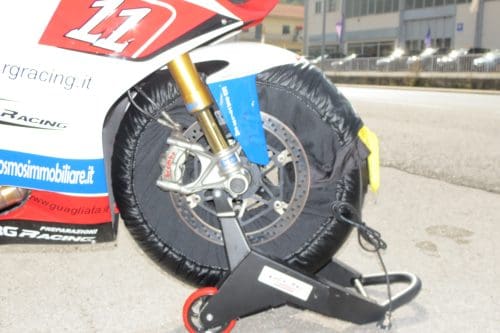

What happens when you stop between shifts?
Every innovation stems from a real problem observed during testing. In our case, the problem was pressure stabilisation.
In 2012 IRC Components chose a different path
In 2012, when no one was even talking about pre-heating the wheel, IRC Components decided to approach the problem in a different way. We didn’t just design a heat-insulating cover capable of heating the tire. We designed a solution capable of transferring heat to the rim as well. From this research activity, Integrale was born, the first system patented by IRC Components for the simultaneous preheating of tire and wheel.
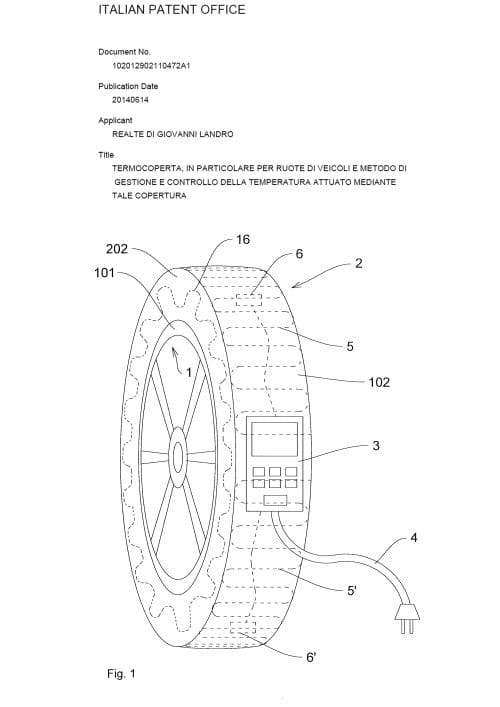
It was also the first thermostat to introduce the concept of ’dual zones“, as evident from the 2 thermostats 6 and 6′ The goal was not to get a warmer tire. The goal was much more ambitious. Reduce the time required for the entire system to reach a stable pressure. For us, innovating means this. Observing a problem. Understanding the causes of them. Develop a technical solution.

The IRC Integral patent, filed in 2012, stems from the need to accelerate the achievement of thermal equilibrium throughout the entire wheel system.
Thirty years of research, not slogans
At IRC Components we have been developing thermal blankets for over thirty years. Meanwhile, the motorcycles have changed radically. The performance has increased. The speeds have increased. The carcasses have changed. The mixes have changed. The suspensions have changed. Even the electronic traction control strategies have changed. For this reason, we believe that thermal blankets must also evolve continuously. Our job is not simply to produce heat. It consists of studying how the heat is distributed. How it is transferred. How it affects pressure. How the dynamic behavior of the motorcycle changes. Because our goal is not to sell a thermal blanket. It is to allow the tire to perform from the pit lane exit under the conditions specified by its manufacturer. And it is a philosophy that continues to guide every new project of our Research and Development department to this day.
Conclusions
The new compounds represent an important evolution and allow for faster reaching a sufficient level of grip. However, they do not change the laws of physics that govern the air pressure contained in the tire. The pressure continues to evolve until the thermal equilibrium is reached between the tire, the internal air, and the rim. And it is precisely this continuous variation that changes the dynamic behavior of the motorcycle in the early turns. For this reason, we believe that thermal blankets continue to play an essential role even with the latest generation of tires. Their task is not simply to “heat the rubber”. Their task is to allow the tire to perform from the pit lane exit under the pressure conditions specified by the manufacturer. For more than thirty years, this has been the philosophy that guides IRC Components. Observe. Studying. Measuring. Innovate. Because in motorsport performance evolves continuously. And the tools must also evolve. Getting on the track with the certainty that the tires and bike are already in the best possible condition, tackling the first corner with the elbow on the ground, is a sensation that does not appear in any technical specifications. But for those who run on the track, the difference between a timed lap and a memory is significant.
QUESTIONS AND ANSWERS FAQ
⚙️ Our Thermo Blankets
💬 Doubts about temperatures or patterns?
Our technical team helps you choose the best thermal cover that is perfect for your tire type.
Use the WhatsApp widget at the bottom left to talk to us right away!