
What Are Thermos Cups For?
(even if you never do a race)
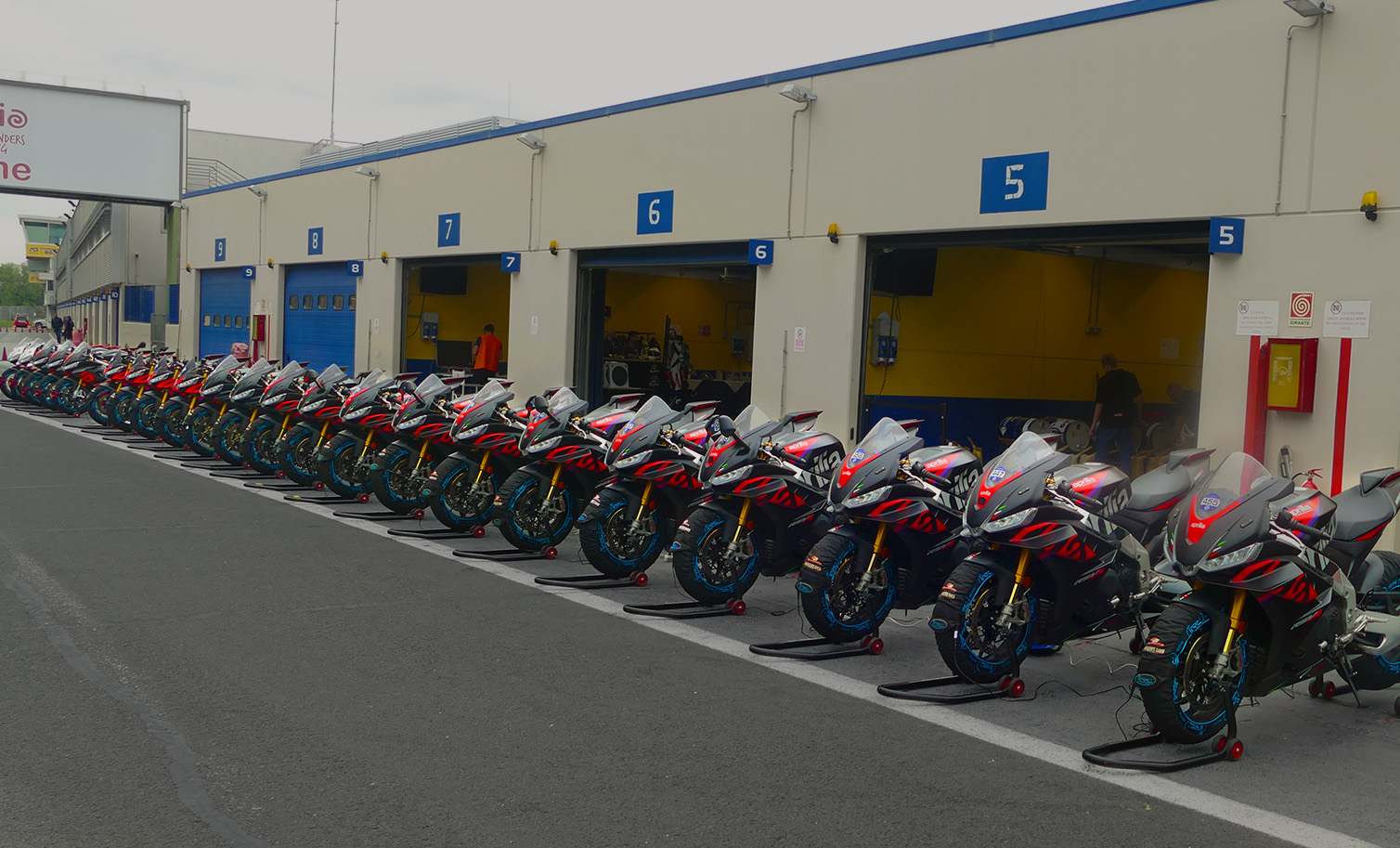
There is a very widespread prejudice, even among those who have been riding for years: thermal liners are "track stuff," a tool for professionals that the Sunday rider has no reason to consider. It's an understandable idea, but partially wrong — and it's worth understanding why, because the answer says a lot about how safety really works in motorcycling.
The true criterion is not speed; it is the thermal variable.
💡 The fundamental mistake is to think that thermal blankets are there to "go faster". In reality, they serve to eliminate an unknown factor, and the unknowns do not only concern those who push the stopwatch. They concern anyone who asks the tire to do something that goes beyond simple straight-line performance: a decisive breakaway, a curve taken with conviction, a steeper inclination than usual.
And here comes the point: that request is not the prerogative of the track. It’s the same exact gesture you make on a mountain trail at eight in the morning, on a highway that’s covered in dew, on a road you take every day to go to work and that one day, for a dog crossing the road or a car cutting you off, you’re asked to brake like you wouldn’t normally do.
The context in which the risk is higher: the "non-track day"
Paradoxically, those who go on the track are often more protected than those who go on the road every day. On the track, you know what to expect: you drive on a clean track, closed off from traffic, often after carefully checking pressures and temperatures. On the road, however, the unexpected is the norm, not the exception — and it happens right when the tire is least ready: as soon as you leave home, in the first few minutes of a lap, after a stop at the bar during a group outing.
It is in these moments — not during quick laps at a track day — that a large proportion of motorcycle accidents related to loss of grip are concentrated. Not because skill is lacking, but because there is a lack of awareness that the tire, in those early minutes, is still working outside its optimal window.
Who uses thermal blankets off-road, and why
More and more motorcyclists who frequent alpine passes, rallies, organized tours, or simply group outings in intermediate seasons bring along a set of thermal jackets, even just for the first few minutes before setting off. They do it not for the stopwatch. They do it because they know that the first stretch of road — the one where concentration is still as "cold" as the tire — is statistically the most delicate part of the entire outing.
There is also a category that uses them in an even more targeted way: those who ride high-performance motorcycles on the road, that is, vehicles that, at the same speed, require tires with more performance compounds, designed to perform well precisely in the higher temperature range — and therefore are penalized, proportionately, by starting cold.
Active safety, not technical whim
In the automotive and motorcycle world, there is often talk of passive safety — airbags, protections, materials that absorb an impact — and less about active safety, that is, everything that is needed to prevent an accident from happening. The management of tire temperature belongs to this second category, along with things like brake maintenance or periodic pressure control.
It is a form of silent safety, which is not seen until it is gone. It does not physically prevent a fall like an airbag would, but it substantially reduces the probability that that fall will occur for a completely avoidable reason: asking a tire to grip when it was simply not yet ready to do so.
An investment that lasts more than one season
There is one final aspect, less linked to safety and more to economic substance: a tire that operates always within its optimal thermal window wears out more uniformly and predictably. Tires brought to the correct temperature, before being run, tend to wear out less quickly than tires that are "heated" with the risk, kilometer after kilometer, in conditions of strain that are not yet optimal.
It is therefore not just a question of "the safer first exit". It is a more intelligent management of a component that, among the many components of the motorcycle, is the one that physically establishes the boundary between you and the road — always, not just on Saturday in the track.
The right question to ask
The question should not be "Am I fast enough to need the thermal gloves?", but rather: "Am I asking my tire to do a serious job, at a time when it is not yet ready to give it to me?". If the answer, even just a few times, is yes — a strong pull in the turn, a decisive curve on a mountain pass, a sudden overtaking — then the temperature variable is not a detail for specialists. It is one of the few things, on a motorcycle, that you can completely control before you even leave.
QUESTIONS AND ANSWERS FAQ
⚙️ Our Thermo Blankets
💬 Doubts about temperatures or patterns?
Our technical team helps you choose the best thermal cover that is perfect for your tire type.
Use the WhatsApp widget at the bottom left to talk to us right away!